

Accompaniment for the demands of leadership.
*
Accompaniment for the demands of leadership. *

The Noesis Approach
See clearly. Deepen awareness. Act with judgement.
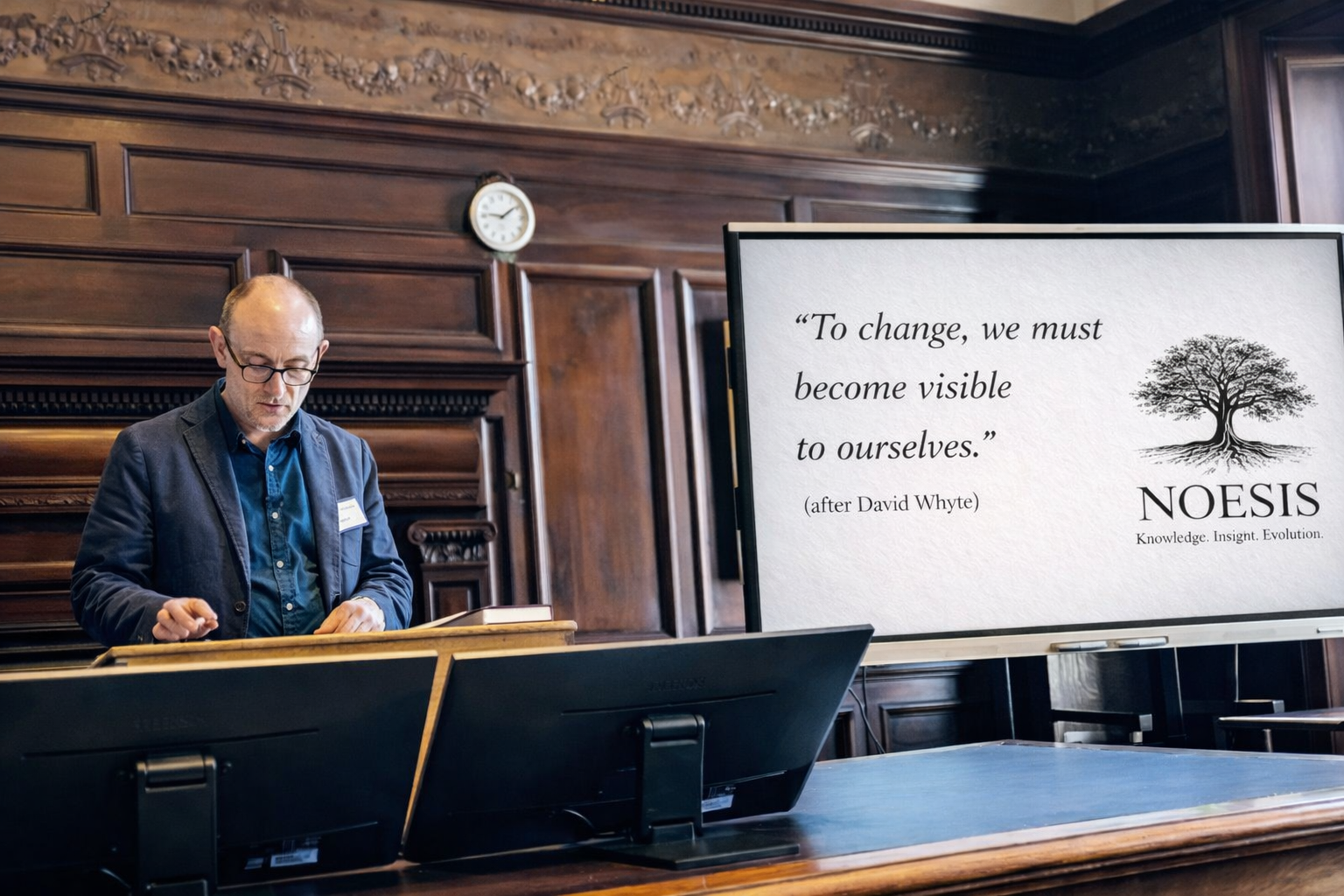
The Noesis approach is shaped by a simple process: seeing things as they are more clearly; deepening awareness, meaning and insight; and acting with judgement.
This is not a rigid method or a formula imposed on every conversation. It is a way of describing what coaching can make possible when there is enough space to think carefully.
Noesis begins with the belief that good thinking needs room. When people hold responsibility, or feel themselves stuck, the pressure to respond quickly can make it difficult to notice what is really happening. The urgent, the familiar and the loud can easily crowd out the deeper questions.
See clearly
The first movement is to see more clearly.
This means slowing down enough to notice what is actually happening: the presenting issue; the wider context; the pressures being felt; the assumptions being made; and the patterns that may be shaping the situation.
Seeing clearly is not always comfortable. It may involve recognising what has been avoided, over-managed, tolerated or misunderstood. But without this kind of attention, action can easily become reactive.
Deepen awareness
The second movement is the deepening of awareness.
This is not something the coach does to the client. It is developed relationally, through careful listening, reflection, challenge and attention to what is emerging in the conversation.
Psychological insight may be useful here, but always in the service of the client’s own understanding. Coaching may involve noticing emotion, identity, values, relationships, systems, conflict, power and the ways people protect themselves or adapt under pressure.
Awareness deepens when people begin to hear themselves more clearly, recognise their own patterns, and understand more fully the situation they are part of. The coach’s role is to listen closely, notice patterns, offer challenge and help the client discern what otherwise might be obscured.
Act with judgement
The third movement is action.
Noesis is not concerned with reflection for its own sake. The purpose of the work is to help people move towards clearer decisions, better conversations and more grounded forms of action.
Sound judgement may lead to making a decision, having a difficult conversation, setting a boundary, clarifying a role, naming a value, changing a pattern, or choosing not to act at all.
The action that emerges from coaching should not simply be efficient; it should be grounded - appropriate to the person and the situation; marked with greater clarity, awareness and purpose.
‘As always, I am enlightened when speaking with you.’
A coaching client.
What shapes the work
Several strands shape the way I work.
My background in education has given me a lasting interest in formation: how people learn, grow, change and become themselves within institutions and communities.
My academic work has trained me to attend carefully to language, history, culture, belief and practice.
My experience of leadership and organisational life has taught me that institutions shape people, often in ways they do not fully recognise.
My theological and pastoral background has left me with a deep concern for meaning, wisdom, vocation, conscience and the questions by which people live.
My coaching practice brings these strands together in a disciplined, confidential space for thought, reflection and action.
What to expect
In all my work, you can expect a conversation that is calm, thoughtful, direct and humane.
I do not offer formulaic advice, easy reassurance or generic leadership techniques. I work with people to create the conditions in which they can hear themselves more clearly, understand their situation more truthfully, and consider what may now be needed.
The work is reflective, but not abstract. It is concerned with real responsibilities, real relationships, real decisions and real pressures.
At its heart, the work creates the conditions in which greater insight, awareness and judgement can emerge through serious, careful conversation.