
Executive Coaching
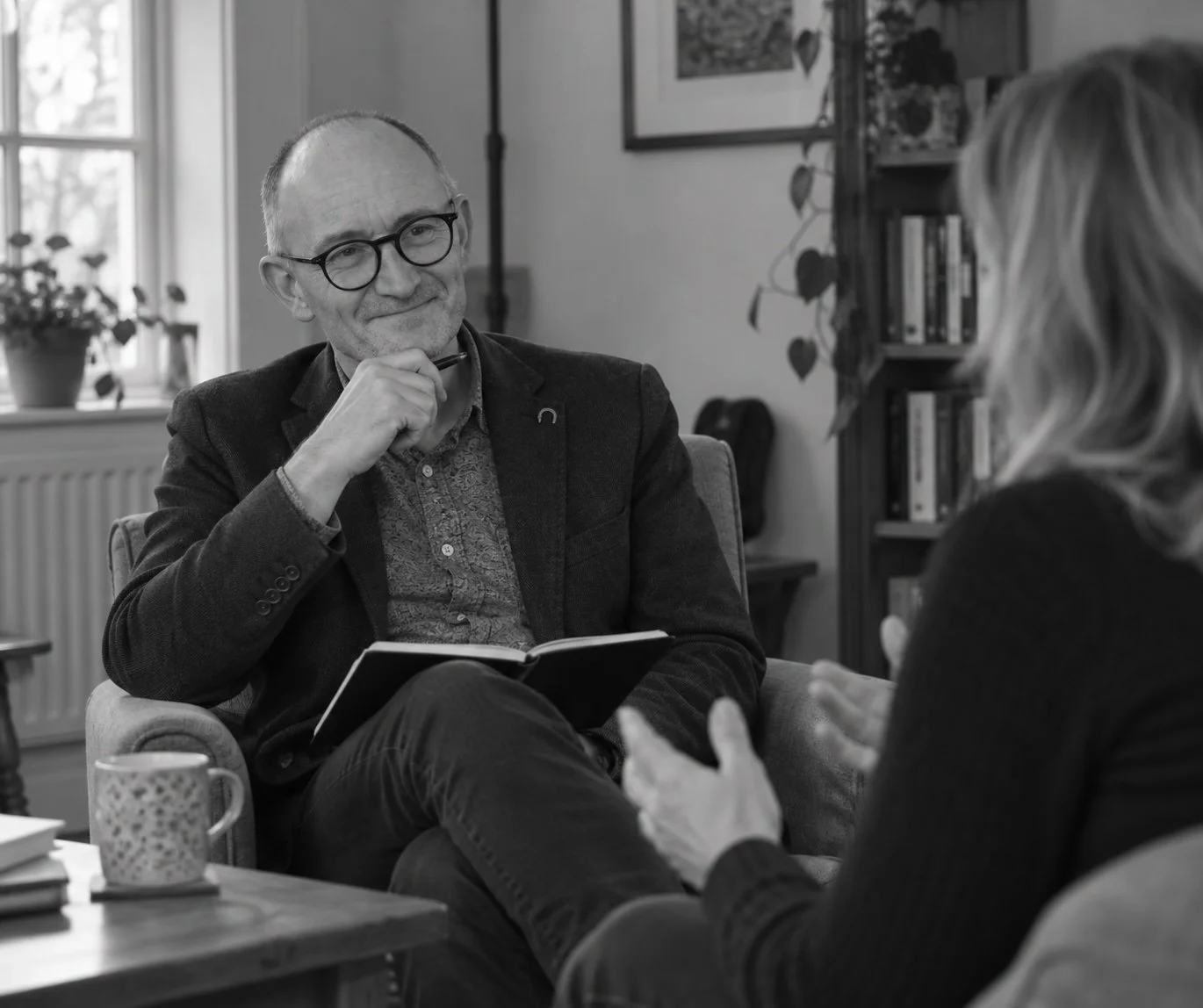
The Coaching Encounter
Coaching is a partnership towards deeper understanding and informed action.
As a coach, I am therefore interested in the whole situation, not only the presenting problem. The person, the role, the organisation, the relationships, the history and the wider context all matter, particularly where leadership involves holding together people, purpose and institutional realities over time. This is not about making things more complicated than they need to be, it is simply what is required if the work is to move beyond surface answers.
Often, what is first brought into the coaching conversation turns out not to be the whole story. A question about direction may become a question about identity. A leadership dilemma may involve values, courage, visibility or authority. A sense of being stuck may indicate that an established way of working, or an established understanding of yourself, has reached its limit. The work is to stay with these questions long enough for something more accurate to emerge.
As our conversation develops, certain questions tend to return in different forms. What is really happening here? What am I assuming? What am I not seeing? What matters most in this situation? What would wise action look like now? And sometimes more subtly, what kind of person or leader am I becoming through this?
Insight on its own is not the point. What matters is whether you are able to think more clearly about what you are facing, to act with greater deliberateness, and to exercise judgement in a way that is proportionate to the situation and attentive to those affected by it.
Why Coaching?
People come to coaching for a range of reasons: their role has changed, a decision is pressing, confidence has taken a knock, a working relationship has become difficult, or the next step is no longer obvious.
Sometimes nothing in particular has gone wrong, but the responsibility itself is enough to require a different kind of conversation, somewhere to think without the immediate pressures of the role or the expectations of others shaping the conversation.
This is not a space for advice or pre-packaged solutions; it is a conversation in which we slow things down enough to notice what is actually happening in the situation itself; the demands it places upon you; the assumptions beneath it, and the possibilities that have not yet been properly seen.
Your situation may include navigating change or uncertainty, holding together competing expectations, making decisions where the implications are not straightforward, or finding a way forward when the situation feels more complex than it first appeared.
Such conversations can also be helpful when you are considering a change of direction, when relationships within an organisation are not straightforward, when energy has shifted, or when questions of purpose, identity or vocation begin to press more insistently.
At other times, the value of coaching lies simply in having a place where you can think honestly, without performance, and without needing to arrive at an answer too quickly, particularly where others are looking to you for clarity or direction.
How Coaching Is Structured
I typically work with people over three, six or nine 90-minute conversations. Three conversations can focus on a particular question, decision or transition; six or nine conversations allow more time for the work to develop. We agree the pace and timing together. A nine-conversation programme may extend over twelve months, and we review the work as it develops.
Sessions usually take place online or in person. Where useful, we can meet in your working context or take a coaching walk. A structured 360° feedback process can also be included where it would support the work. We agree its scope and any additional fees or travel costs in advance.
Fees
The fees below are for organisationally funded coaching. The rate is £200 per 90-minute conversation for those in leadership roles and £300 for CEOs and comparable senior leadership roles.
For individuals funding their own coaching, the usual rate is £175 per conversation. Fees are agreed in advance, taking into account a person’s seniority and circumstances.
Every engagement begins with a complimentary 30-minute conversation to explore what is bringing you to coaching, what you would like to be different and whether working together feels right.
Three-conversation programme
A focused programme for a particular question, decision, transition or leadership challenge.
* Those in leadership roles: £600
* CEO and comparable senior leadership roles: £900
Six-conversation programme
More time to explore patterns, perspectives and possibilities, and translate insight into action.
* Those in leadership roles: £1,200
* CEO and comparable senior leadership roles: £1,800
Nine-conversation programme
For more complex or sustained work, including significant organisational change, vocational transition, succession or a continuing leadership challenge.
* Those in leadership roles: £1,800
* CEO and comparable senior leadership roles: £2,700
A limited number of pro bono places may be available each year. Please enquire about availability.
No VAT is charged.